
Nevada Financial Literacy Standards and Policy Ranking
The Nevada Financial Educators Council (NVFEC) is the state advocacy chapter of the National Financial Educators Council (NFEC). Our role is to advance policy, standards alignment, and statewide action to ensure that Nevada students graduate prepared to manage real-world financial decisions.
The NFEC conducts national research and develops academic standards. NVFEC translates that research into policy advocacy specific to Nevada. Our shared mission is to ensure that all learners graduate prepared to navigate real-world financial decisions by elevating financial education to the same level of quality, accountability, and instructional integrity as other required core academic subjects.

Nevada Financial Education Standards Alignment: A State-Level Policy Assessment
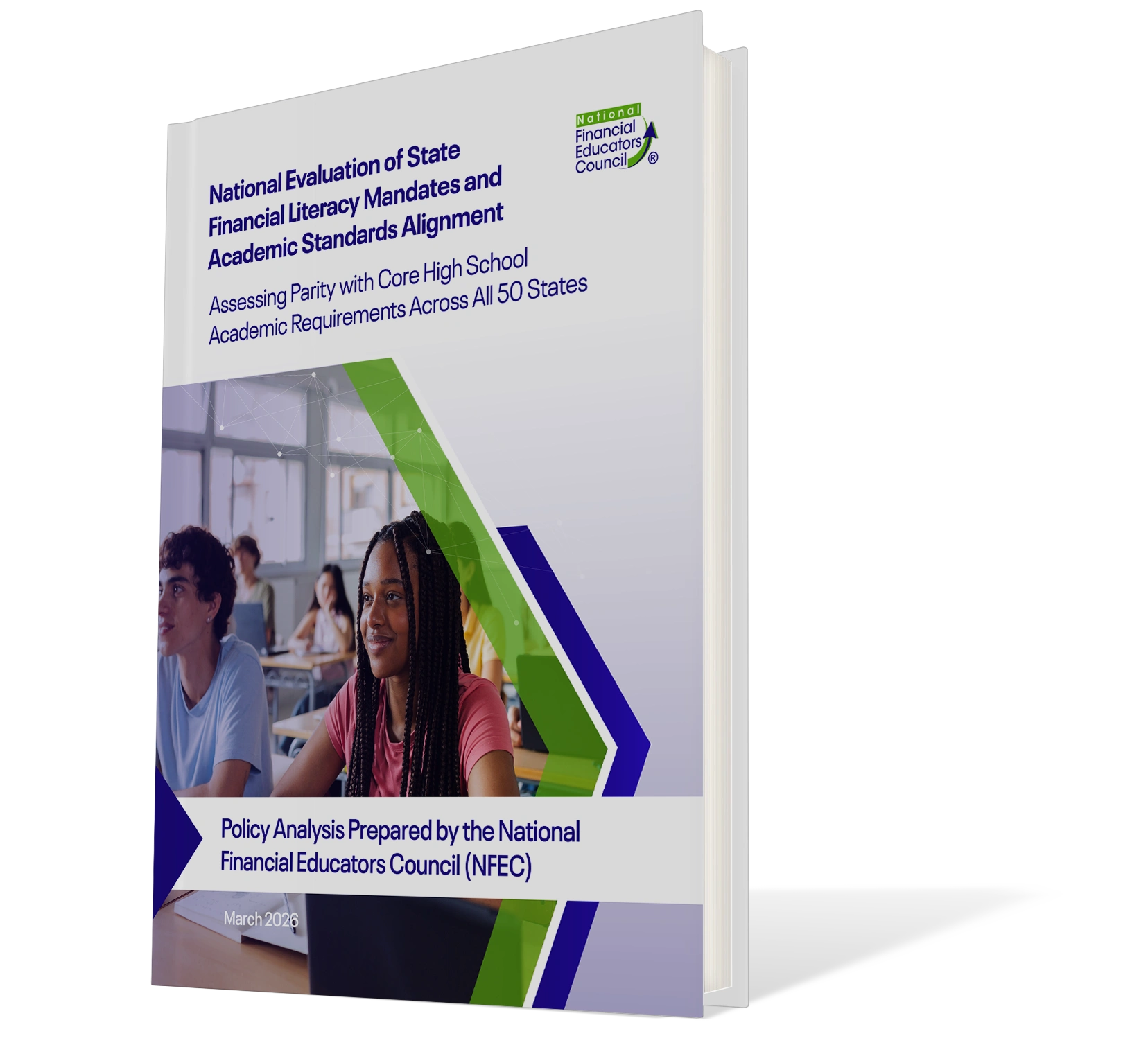
Research conducted by the NFEC indicates that Nevada’s financial education framework falls well short of the baseline expectations typically associated with core high school subjects. With a summative alignment score of just 4.2 out of 100, the state’s overall classification is failing. Using a standardized evaluation model spanning 12 criteria, the analysis reveals that Nevada does not adequately meet foundational benchmarks related to instructional rigor, curriculum structure, governance, or educator preparedness – key components generally expected in established academic disciplines.
A closer look at the distribution of results underscores the depth of these gaps. Of the 12 criteria assessed, 11 were rated as Failing and only one ranked Below Par, with none meeting At Par standards. This pattern suggests systemic weaknesses rather than isolated deficiencies. The NFEC developed this research to support ongoing advocacy efforts aimed at strengthening financial literacy requirements in schools, emphasizing the need for more robust, standards-aligned policies to better prepare students for real-world financial decision-making.
NVFEC’s Advocacy Focus in Nevada
NVFEC works to ensure that financial education is treated as a core academic subject rather than optional enrichment. Our advocacy is organized to advance priorities that align Nevada’s policy environment with established academic expectations.

Closing Statement
Nevada’s students deserve more than exposure to financial concepts; they deserve real preparation for the financial decisions that shape adulthood. These findings reveal a clear opportunity to strengthen financial education by aligning it with the rigor and accountability applied to other core subjects.
By advancing standards-based reform and investing in quality implementation, Nevada can ensure that every student graduates financially prepared for life beyond high school. Meaningful progress requires collective action from educators, families, policymakers, and community leaders – working together to make financial education a foundational part of a future-ready education system.